LYNX combines guided assembly and automated visual inspection to eliminate errors, improve productivity, and ensure full traceability.
Watch Video
LYNX2 Automated Visual Inspection System
The LYNX2 Automated Visual Inspection System is a specialized form of machine vision system. It is designed and built specifically to ensure the proper assembly of complex and often large products where an incorrect, missing, or misoriented item on the assembly causes serious problems when detected far downstream from the initial manufacturing. Think about an EV battery or an aircraft fuselage section that are built in one state that become part of a final assembly across the continent: one missing bracket becomes a serious issue that is costly to fix.
LYNX2 was made to leverage the power of automated machine visual inspection for this application while overcoming the limitations of traditional, general-purpose machine vision. Its unique strengths make LYNX2 the best solution for inspection of large products such as aerostructures, EV batteries, weldments for construction and agricultural equipment, truck and bus chassis, etc.
LYNX improves your assembly process through automation
Eliminate costly quality escapes
Reduce build and inspection time
Replace tedious manual processes prone to human error
Improve final product quality
Increase your staffing flexibility
LYNX replaces manual verification
Verify Every Assembly—Automatically
A bracket installed in the correct location but with the wrong orientation or missing fasteners can create big problems downstream. Mistakes like this are hard to catch, but LYNX will find them.
Guide Operators. Prevent Errors Before They Happen.
The LYNX system ensures proper assembly with projection-guided assembly, using Augmented Reality (AR). LYNX projects high resolution, color images, text and video from the sensor onto the workpiece. Digital, AR work instructions guide technicians through initial assembly by projecting the location and even part number for brackets, fittings and other items.
Nominal range : from 1,5m to 10m Specific application : up to 20m
Distance for AR projection
Nominal : up to 8m of radius
Speed
From 1,000 to 2,000 features per hour depending on the application
Weight
15 kg
Dimensions
L.320 x W.292 x H.570 mm
Connection
Ethernet local or shared network
Why Choose LYNX
Simple Software
Camera
Lighting
Zoom Lens
Flexibility
Faster Analysis
Documentation
Simple Software
Simple and intuitive software
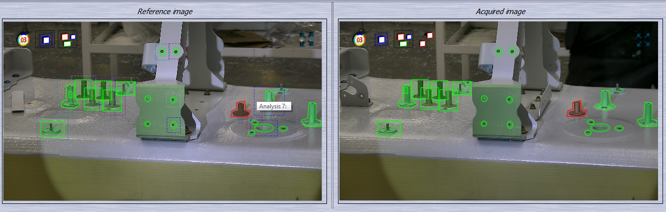
The LYNX2 software is powerful, yet quite simple to utilize. There is no programming or scripting required. Teaching is simply a matter of acquiring reference images for a “golden” part, identifying areas of interest by (circles, rectangles or freeform) and specifying the type of inspection.
All LYNX2 machine vision inspection applications are addressed utilizing standard off-the-shelf hardware and software deliverable. System implementation does not require extensive application-specific design for camera mounting, or lens and lighting configurations and as do most general-purpose machine vision systems. When additional sensor heads are required for line of sight, another standard sensor is added and programmed with little extra effort.
Camera
Camera and light articulation
The LYNX2 system is equipped with a built-in camera and projector. The camera and projector articulate together with a large range of motion (Pan 540˚, Tilt 250˚) for very large inspection volume. Integration with robots or other motion control systems is not required – the camera and projector motion are easily configured within the LYNX2 software. With this capability, a single LYNX2 sensor can inspect a large part or multiple parts, often inspecting hundreds of features with single sensor head.
Lighting
Powerful lighting
The LYNX2 sensor includes an integrated digital projector with 1000 Lumens. Influence from ambient lighting is minimized and rarely requires additional protection from ambient light. This lighting tied with the camera ensures consistent images for visual inspection.
Zoom Lens
Zoom lens
The LYNX2 system includes a color camera with built in autofocus zoom lens with up to 30x optical zoom. LYNX2 can therefore inspect many features in a single image or zoom in on small features to inspect based on minor differences. The level of zoom can be adjusted for each checkview. The LYNX2 system can inspect objects from 1-10m away from the LYNX2 sensor.
Due to its large range and zoom lens, the LYNX2 system can be mounted in an area that provides best balance between line of sight and physical safety. Rather than mounting multiple cameras close to the object to be inspected like most machine vision inspection, LYNX2 can be mounted away from the part to avoid causing interference with operations and prevent physical damage to the sensor.
Flexibility
Flexibility
The LYNX2 visual inspection system is flexible for future applications. The modification of an existing inspection program or addition of a new part to inspect is easy to accommodate thanks to the programmable, articulating sensor head. The user simply teaches the LYNX2 system where to look and what to look for on the new part and the new inspection is added.
Faster Analysis
Faster, Easy to Understand Analysis
After a series of images is collected on a reference part, areas of interest are highlighted in the software. As the LYNX software compares the current assembly to the reference, any variations are automatically identified.
Documentation
Traceability and Documentation
Reports are automatically generated and preserved that fully document the condition of your assembly when it was built. Reports are customizable to include the items you wish to document.
Machine visual inspection is a technology-driven process that uses cameras and image processing software to inspect and analyze products, components, or assemblies for quality control purposes. This method leverages the capabilities of imaging technology to automatically identify defects, verify proper assembly, and ensure that products meet specified standards.
Unlike manual inspection, which relies on human vision and judgment, machine visual inspection provides consistent, repeatable, and objective assessments of product quality. Inspections are typically performed right where the assembly takes place so that any flagged defects can be quickly and easily corrected, preventing major quality issues later in the process.
This usually turns out to be an ideal situation. LYNX can be easily programmed to check a new or modified assembly. These are stored to create a library that can be accessed at any point in the future. Many LYNX users have short runs or may only produce certain assemblies infrequently. Once the program has been stored, you can access it at any time. If you are using the AR version of LYNX it will also speed your production of assemblies by projecting images and part numbers in the correct location.
LYNX provides better images that are projected in color allowing more information to be conveyed. The system has a flexible inspection envelope that allows the inspection of large or small assemblies. LYNX has a greatly expanded view angle since the camera can rotate 360°. When analyzing assemblies, the crisp displays on your computer screen are much easier to interpret than 3-D scan data. LYNX provides documentation of the inspected assembly including images which gives you proof of the as-built condition of the inspected features. Production operators also prefer projected color pictures instead of annoying laser line projections on the part.
LYNX relies on image comparison. This is much faster than any scanning technique since the image capture and processing are quicker. The exact time required will depend on your application and is determined by the number of features you are checking. However, we typically inspect well over 1,500 features per hour from a single head. Even greater speeds are obtained by additional sensor heads.
The only requirement is to have a line of sight from the LYNX camera to the part. If you have larger parts or need to capture information on the back side of an assembly you can add additional LYNX heads.
The position of the LYNX head and the assembly you are checking must be in approximately the same location to each other. This is typically done with simple stops or other mechanisms to locate the assembly. The LYNX does not require expensive fixtures or tooling. You also can set the positioning tolerance for individual items being checked.
LYNX can be relocated but the part and camera must be in a repeatable location relative to one another. There are many applications that incorporate some movement. For example, the LYNX may slide into position on a rail or the part might rotate on a fixture. However, it may be more efficient and cost-effective to add an additional head to the LYNX system.
No. LYNX is entirely image-based. But an image-based system also has an advantage in capturing information that is not easily available in CAD. Digital images allow much more information to be processed including changes in the appearance of the subassembly, color, and other elements.
LYNX is a natural fit for the assembly of large objects that benefit from its extended range. These include airframe subassemblies, jet engines, weldments, construction vehicles, etc. Most often it is used with assemblies that fit in a volume of 1 meter x 1 meter, to 10 meters x 10 meters, but there is no limitation on size since additional heads can be added.
Accurex provides on-site installation and training services for all systems sold in the United States and Mexico. We can also provide on-site support service if you need help with a particular set up.
Accurex has staff in locations around the USA. Our main support locations for LYNX are in Pennsylvania, Michigan, Kansas and California. We can help with many issues remotely which will provide the fastest resolution to your questions but will also come on-site to help you if needed.
Hear what our customers have to say
Watch Video
Why LYNX
By locating defects quickly we are realizing true cost savings by reducing rework cost.
This tool it helps us tremendously because it helps us find mistakes the naked eye would normally not find and it gives us a better part to give off to the customer as well.
Since the installation of the system LYNX on STELIA Aerospace production lines, we significantly reduced our rates of non-conformities and thus have been able to improve our productivity.